
Manual PO release-Single Supplier to Automated EDI releases to Multi-Supplier
In the Supply Chain - Procurement process, for any material purchase, the single supplier are chosen based on the quotation from multiple suppliers in order to process each Purchase Order.
Scope:
The existing procurement process of selecting a single supplier, for each material based on manually analysing the quotation is not a proper match for the business. Since the final selected single supplier for a materaial, was also failed with his commitment in several cases and reflected loss in the business.
Instead of Manual purchase orders to single supplier for a material can proceed with multi -supplier for a single material and EDI (Electonic Data Interchange) releases instead of Manual Purchase orders based on Quota allocation will be a proper match for the business.
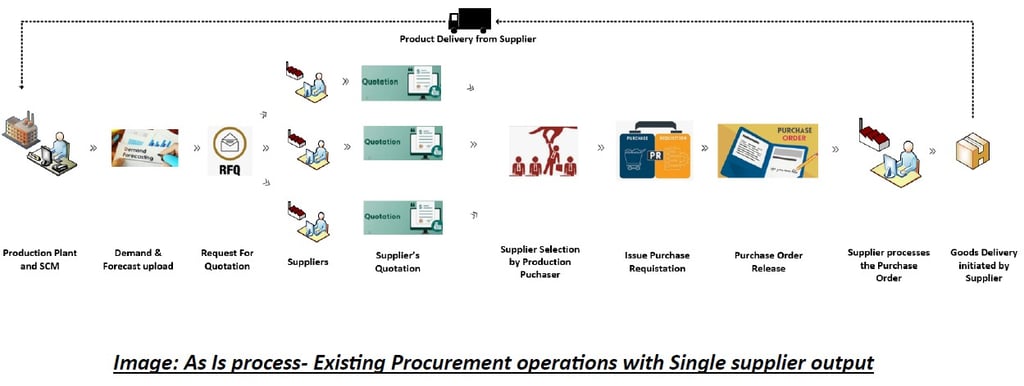
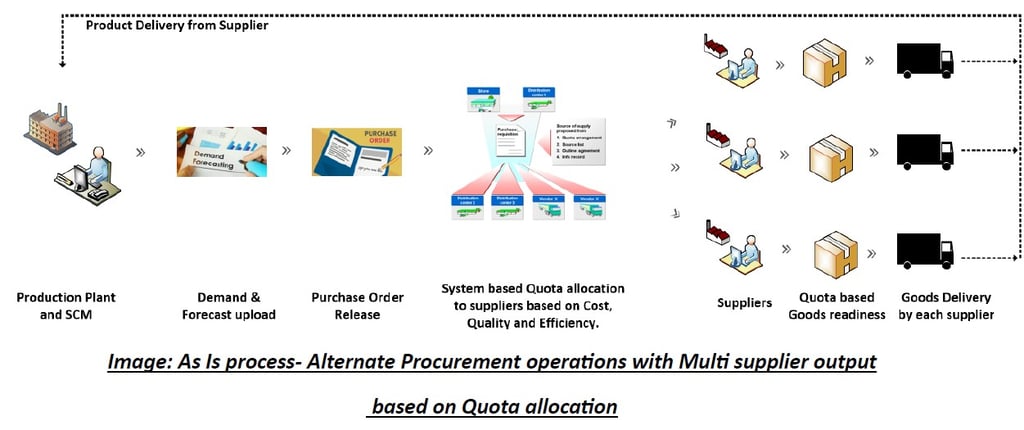
Current State
Future State
Analysis tools used: Gap Analysis, Cost – benefit analysis, SWOT analysis, Business Process Modelling.
Tools used for development: Jira, Confluence, QAD ERP, Alteryx.
Methodology: Hybrid (Agile & Waterfall)
Timeline : 6 months
As Is Process / Existing system:
❖ Production Plant Purchase team uploads the demand forecast to the system.
❖ Based on Demand Forecast , the RFQ is generated and shared to different suppliers. Based on RFQ, each suppliers generates a quotation to the plant purchase team.
❖ Purchase team analysis the quote and selects the supplier for the part based on cost, quality and efficiency.
❖ Once the supplier is confirmed, the purchase request is created and converted to Purchase order.
❖ Based on the purchase order, the supplier ships the part.
Gap Analysis:
• There are numerous parts to be triggered with PO. Analysing each quotation is time consuming
• Supplier selection cannot be done efficiently with existing approach
• Excess Manual intervention in the process.
To be Process / New System:
❖ Once the Demand & Forecast is uploaded by the production purchase, the Open Purchase orders are created.
❖ The system automatically triggers the quotation price for each material to the supplier and analysis the supplier with and updates the quota percentage for each supplier based on their price and previous data on quality rejections and supplier efficiency details.
❖ Each supplier listed in the system will receive the supply requirement quantity based on the quota allocated by the system.
❖ For each material will have multi-supplier delivering the part based on EDI supply requirement.
Benefits:
• Supplier selection, quota allocation will be completely managed and automated by the system. The system allocates equally to all the listed suppliers based on their cost, quality and efficiency.
• For the same part, we can have supply from different suppliers based on their quota allocation. Thereby the safe approach on part supply continuity
• Since the allocation quota is based on the cost, quality and efficiency of the supplier. If any issue is marked to the supplier will have reduction of quota for the particular supplier and the reduced quota will be matched with other suppliers quota increase.
Contact
Phone
krishhh1991@gmail.com
+61-455435496
© 2025. All rights reserved.
LOCATION
East Perth, WA-6004